
Marlene Dietrich owned one. So did Edith Piaf, Maurice Chevalier and Sandra Bernhardt – in the latter’s case presumably before she lost her leg.
Browse through the yellowing pages of the old order books at French bespoke cycle manufacturer Maison Tamboite and you’ll find the names of all these legends of 20th-century stage and screen.
They are a reminder of the time, around 100 years ago, when the firm’s bikes were a much sought-after accessory for the A-list of Parisian society.
It hasn’t all been plain sailing since then, though. In the 1990s, under pressure from changing tastes and overseas competition, Maison Tamboite shut its doors, seemingly for the last time.
The business lived on, however, in the memory of Frédéric Jastrzebski, great-grandson of Léon Leynaud who founded the company in 1912, and someone who had hand-made bikes in his blood.
A workshop childhood
Jastrzebski had carved out a successful career in the finance industry, but he had not forgotten his roots within the family business.
He recalls: “I spent most of my childhood free time in the workshop watching people building bikes. When the business shut down in the early 1990s I was too young to take over, but I couldn’t accept that the work of three generations would be lost forever.
“When I had the opportunity to change career a few years ago, this seemed to be the obvious thing to do.
Today, Maison Tamboite’s headquarters can be found tucked away down a quiet, cobbled street a few minutes’ walk from the hustle and bustle of the Place de la Bastille in Paris’ 11th Arrondissement.
Within its quiet precincts the firm’s creations begin to take shape; its products a glorious mélange of sparkling chrome, gleaming wood and lustrous paintwork.
Says Jastrzebski: “We have created a whole eco-system of craftsmen, mainly Parisian. A dozen trades come into play to produce all the technical and aesthetic elements of one of our bikes. Polisher, enameller, leatherworker, cabinetmaker – all combine their talents.”

Keeping it simple
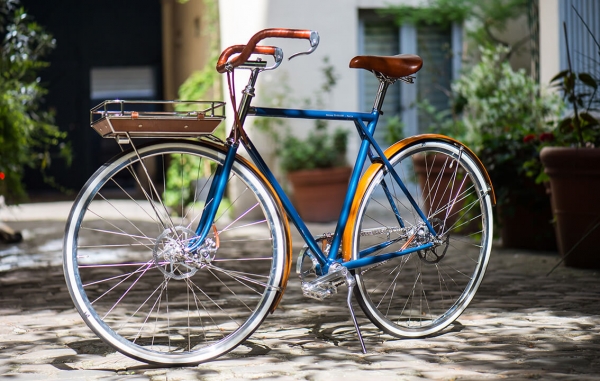
In one sense, though, Maison Tamboite keeps its offerings relatively straightforward. It has three guideline styles of bike on offer; the sportingly styled, single-speed Marcel, featuring retro-inspired wooden wheel trims and drop handlebars; the more relaxed Henri, with two gears, beech-wood mudguards and a distinctive basket for carrying everyday kit; and the Dalou, incorporating a traditional women’s-style frame.
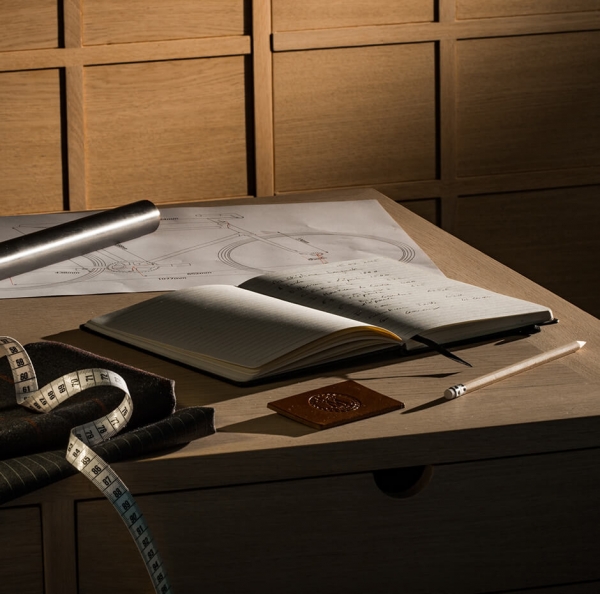
Each of these represents just the starting point in the process. Jastrzebski’s aim is to bring the principles of bespoke tailoring to bikes – his clients don’t just buy off the peg. Instead, they have at least 15 measurements taken, including their height, the length of their arms and the distance from knee to heel. They can also select from a palette of 17 distinctive colours.
All this information, Jastrzebski explains, allows Maison Tamboite to produce bikes that are not only stylish but also remarkably comfortable; designed for the individual and capable of making negotiating the modern city a veritable joy. That said, the manufacturing process also requires an element of patience – it takes around two to three months for the machine to be crafted prior to delivery.
Passion for quality
Everything from lightweight steel tubing, to smooth wooden wheel rims, to hand-stitched leather seats are sourced from European manufacturers that share the firm’s passion for quality craftsmanship.
With a price tag of around €11000 (€15,000 for electrically powered versions) the end result is an elegant, sleek machine that is as much a luxury accessory as a way of getting from A to B.
While the bikes retain overtones of retro design and vintage charm, Jastrzebski is quick to point out the business isn’t about turning back the clock to the glory days of the 1920s.
“Yes, the history of the brand has been an influence in our methods, but we also try to do things differently to other firms,” he explains. “Our aim is to emphasise the value we can add to our existing DNA and to use that to justify our presence in the market.”
“There are a lot of tributes within what we do, such as the central position of the client and the quality of the materials we use. But we also add an extra touch. We make sure that each piece is special. If you want to succeed [in business] in Paris you really have to think hard about who you are, what was extraordinary about your history and how to push that to the next level.”
The firm is also now increasingly widening its horizons, with customers in the Middle East and Africa. Maison Tamboite has also worked with a tailor in Seoul, South Korea, the latter taking orders and measurements, which are then passed back to Paris to be transformed into bikes.
However, while this growing international order book is something of which Jastrzebski’s ancestors would surely be proud, he politely declines to reveal if its pages currently contain the names of any A-listers to compare with the likes of Dietrich, Piaf, Bernhardt et al.
The historic Parisian firm turning its hand to bespoke bikes.
Tweet
 Dan Hayes: journalist & writer