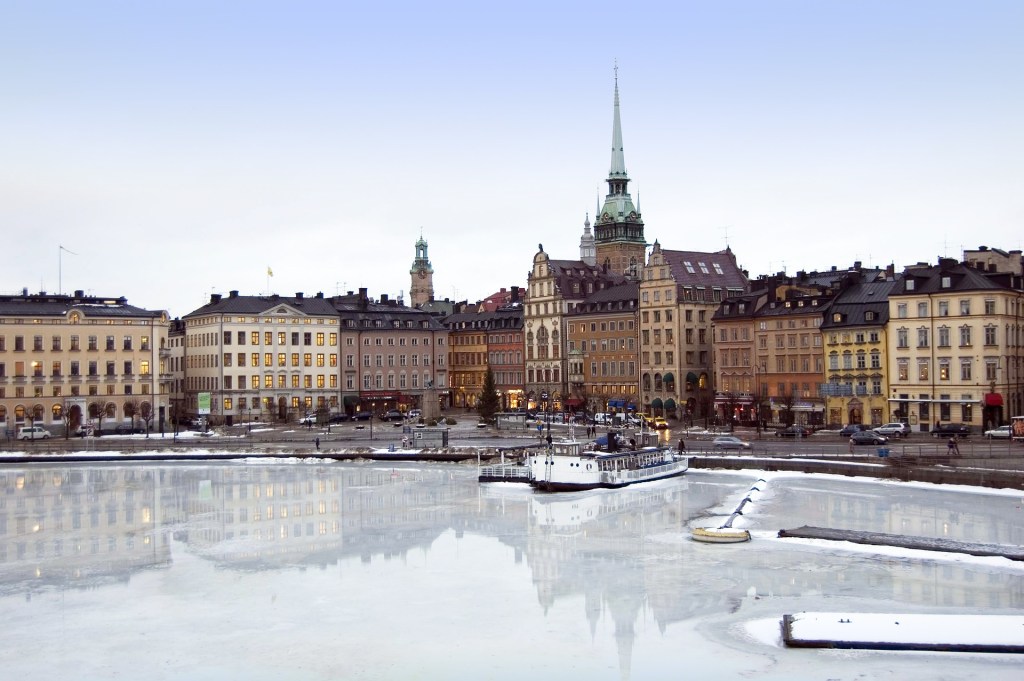
Low winter sun is lighting up the buildings of Stockholm’s Gamla Stan with a warm, golden glow. My watch is showing a little after 8.30am, but the daylight is only just beginning to break through the early morning mist, casting reflections across the waters that flank this most handsome district of the Swedish capital.
‘Gamla Stan is the oldest part of the city,’ says Nina Lindgren, a life-long Stockholm resident and seemingly an enthusiast for everything it has to offer. ‘It’s the place most visitors head to first, partly because it’s such a historic area and partly because there’s so much to see and do here.’
It is also somewhere that has a romance all its own, with narrow, cobbled streets leading to wide squares that are lined with café tables in summer. At the impressive, Baroque-styled Royal Palace visitors convene three times a week – in winter – to observe the changing of the guard ceremony. Perhaps in keeping with Sweden’s rather democratic approach to monarchy, the event appears comparatively understated, with youthful soldiers in heavy, blue-grey greatcoats and distinctive, bright-white spats, marching, wheeling and stamping – largely in time with each other.
‘It’s more of an event in summer,’ Lindgren points out, slightly apologetically, ‘when they have full bands playing music and it’s all very bright and colourful.’
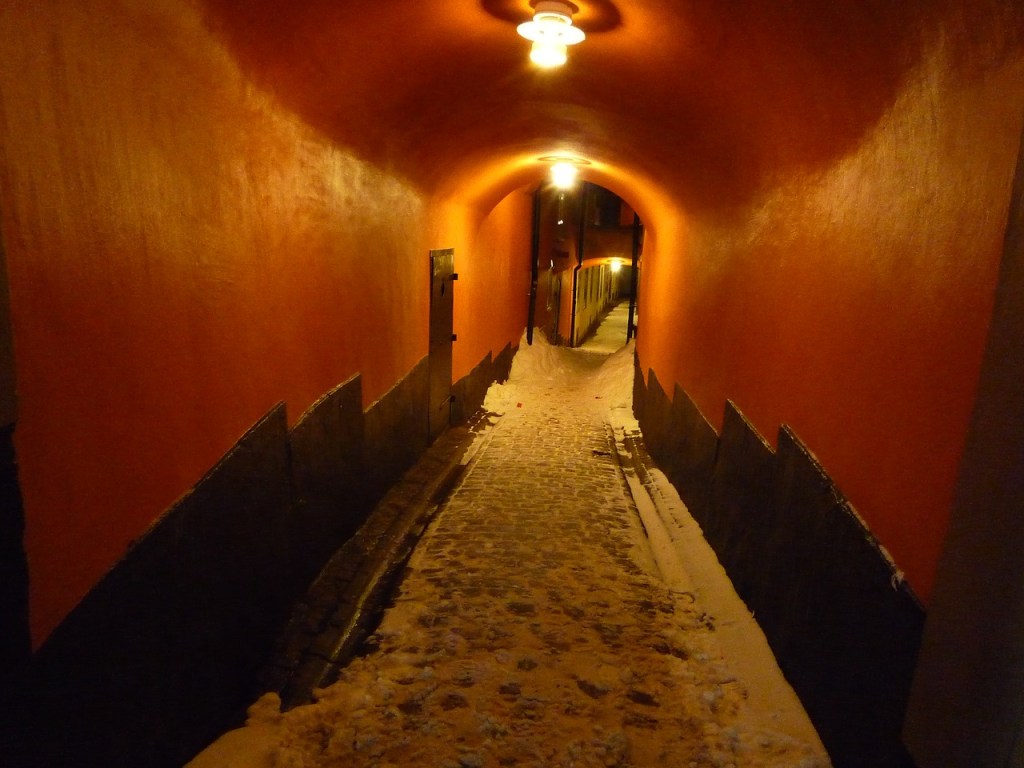
The truncated palace guards’ ceremony is perhaps indicative of the profound differences between winter and summer in Stockholm. In the dark, cold months there is a sense of hibernation not only to the capital, but to the whole of Sweden; a feeling of suspended animation that is punctuated by occasional bursts of colour – in the form of New Year’s Eve fireworks, a blaze of light from a street-side restaurant or in a crocodile of brightly clad school children crossing a snow-covered suburban street.
Light and darkness
Even in relatively mild Stockholm, the temperature rarely rises above freezing between December and February, with darkness stretching from 3pm to 9am. The urge to shut yourself away with a good book and a glass or red wine is strong.
Light takes on an almost religious significance, perhaps most obviously on 13 December – the festival of Santa Lucia – when a procession of children dressed in white robes and holding glowing candles moves through the streets and squares of Gamla Stan. It is a magic moment for the youngsters – and for adults, too. Faces are lit up by the candlelight – though those worn in participants’ hair tend these days to be powered by electric bulbs – and there is a palpable sense of wonder and excitement in the air.
The festivities can trace their origins back to a somewhat bleaker episode, though, as Lindgren points out. ‘The original Lucia was a Roman who helped the early Christians when they were in hiding in caves beneath Rome. To keep her hands free to carry food and water she’d put candles in her hair to give her light in the underground passages.’
Unfortunately, as was often the way with saints in ancient Rome, things did not end well. Lucia was caught and promptly martyred in 304AD.
Not unusually for Scandinavia there is more than a hint of the pagan about proceedings. Many of the children’s heads are ringed by garlands of evergreen leaves, a reminder that nature endures even in the darkest depths of winter – 13 December was, under the old Julian Calendar, the shortest day of the year and a time when evil spirits would make the most of the long hours of night to get up to mischief.
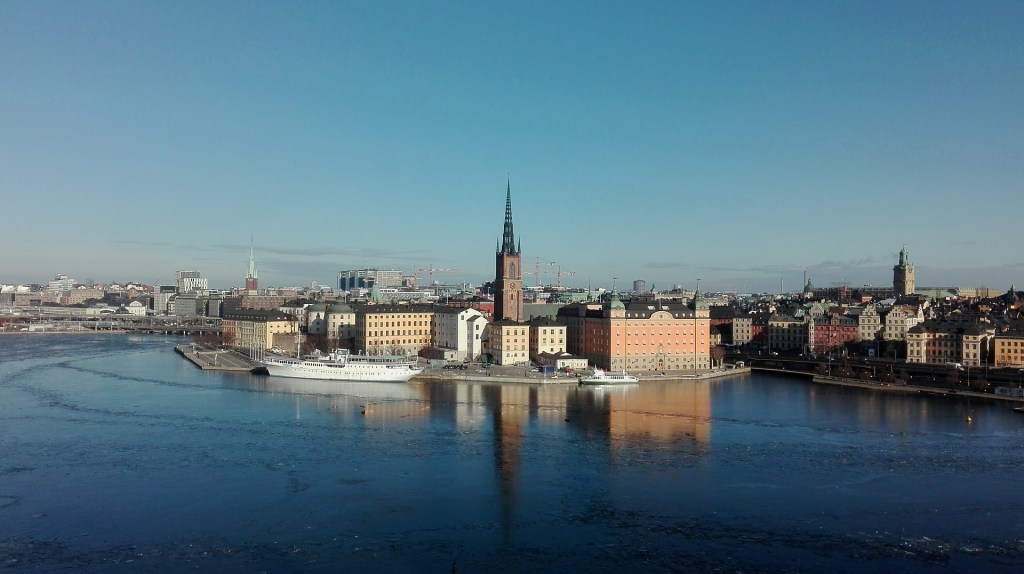
These days, though, the Santa Lucia procession reaches its conclusion in the solid precincts of the Stockholm Cathedral, known as Storkyrkan or big church, close to the Royal Palace, where hymns and carols are sung in anticipation of the upcoming Christmas festivities and its attendant feasting on glazed ham, meatballs, pickled herring and a Smörgåsbord of other delicacies.
Santa Lucia signifies a turning of the tide, the moment when light imperceptibly begins to gain mastery over darkness and when people can begin to look forward to long days of summer when the character of Stockholm changes, with life being lived outside and every hour of sunlight savoured.
Picnics are enjoyed in parks that have been locked under snow for months, early morning swimmers take to the waters at Långholmen, close to Gamla Stan, before sunbathing on its wooden pontoon, and revelry stretches into the night at the midsummer festival in June, when pickled herring and fruit-flavoured schnapps are downed with equal alacrity and Swedes let down their collective hair with uninhibited enthusiasm.
Escape to the country
For this festival in particular, and for the summer months in general, many locals make sure they escape from the city – attractive as it is – to cottages out in the Stockholm Archipelago and in the wider countryside.
‘Lots of people own a summer cottage,’ Lindgren explains. ‘Our family has had one since the Sixties, though the building actually dates back to around 1900. It’s built entirely of wood and is a classic example of a traditional country house.
‘What’s important in terms of its design is simplicity, functionality and light. In summer we want to make the most of the sunshine because in the winter we don’t see much of it. So we have stripped wooden floors, simple furniture and south-facing windows.’
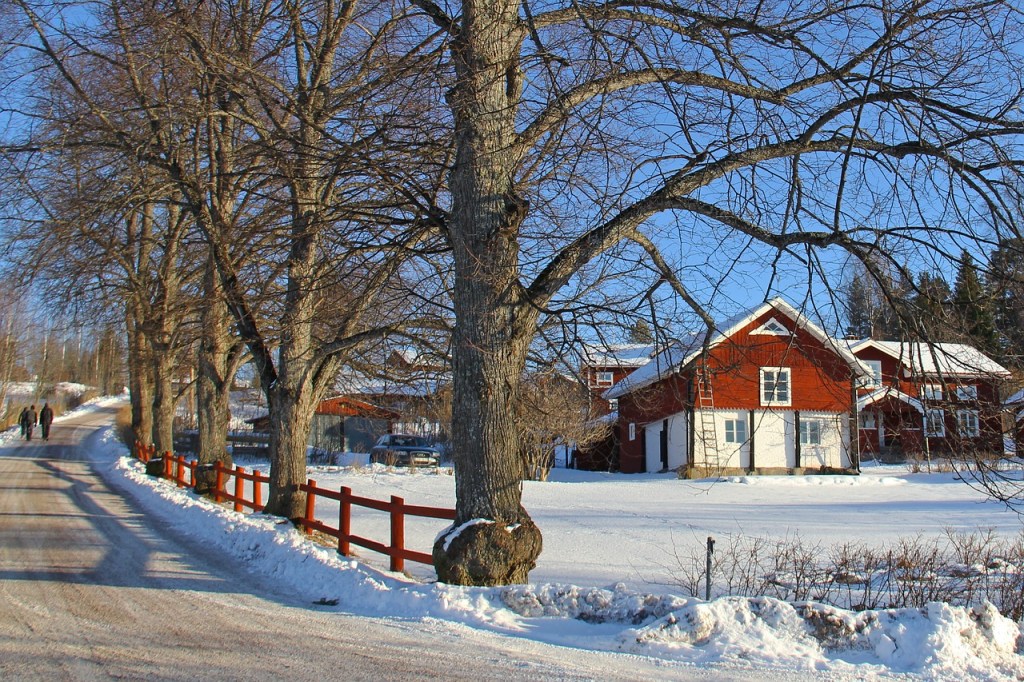
‘Outside it’s painted in a famous red colour known as falu rödfärg,’ she adds. ‘Traditionally, that was made from by-products of copper mining and it is used on wooden houses to make the timbers resistant to wind and rain. It also looks pretty good against the dark green background of a forest.’
To find out more about that cultural heritage and the locals’ desire to get away from it all in summer, I make my way to Stockholm’s Nordiska Museet, a showcase of Swedish traditions on the island of Djurgårdsvägen, adjacent to Gamla Stan. Here I meet up with historian and folklorist Jonas Engman, who tells me the Swedes’ love affair with the country cottage can be traced back to the 19th century: ‘That was when middle-class people from Stockholm began buying up second properties out in the Archipelago. They wanted to connect to a notion of their origins and to find the spirit of nature.’
The irony, he adds, was that their cozy concept of the peasant life was a long way removed from reality. ‘They wouldn’t have liked the real thing very much,’ he says, ‘it would have been horrible; cold, smelly. There wouldn’t have been anything much inside most houses – not even food. In the 19th century Sweden was one of the poorest countries in Europe.’
Engman, though, has fond memories of his own family’s summer cottage, in the southern province of Skåne. ‘My parents bought a place in the late 1950s and I spent summers growing up in the sunshine. We were the incomers from the big city and we were regarded as very exotic. I was the only person in my school class who’d seen a pig or a cow. I even got to drive a tractor on one of the local farms.’
‘All the way from the Sixties to the Eighties people found they couldn’t make farming pay and so they moved to the cities. At the same time middle class people bought up cottages in the country. That phenomenon is still happening today. People are trying to express an idea of what it means to be Swedish, wanting to retreat to a countryside where they think they belong. We’re striving to create an aesthetic that we’re copying from late 19th-century art and design.’
The myths are deeply ingrained, he suggests. Even that famous red hue, falu rödfärg, isn’t quite what it seems. ‘It wasn’t until around 1850 that Swedish people even began to paint their houses,’ remarks Engman. ‘Before that they’d have been grey – the colour of wood as it ages.’
A history of homes
I don’t have to travel far to see an example. Skansen – an open-air museum that uses 150 rescued buildings to tell the story of Swedish home life, design and culture – is also on Djurgårdsvägen and it includes just such a house among its numerous exhibits.
In December, Skansen hosts a Christmas market, complete with carol singers and infused with the smells of gingerbread and glögg (mulled wine), but that is just one of the place’s many attractions – as the museum’s Christina Hamnqvist makes clear as we walk past building after building that has been transplanted lock, stock and barrel from across the country.
‘People come here to celebrate all the major festivals of the year, including Santa Lucia on 13 December. We even invented the Swedish National Day on 6 June,’ she says.
We stop in a cobbled street, flanked by a row of 19th-century town houses, painted in shades of yellow and orange and with rough-hewn wooden shutters designed to keep out the worst of a northern winter and the excesses of summer light.
‘Visitors come here to connect with their past and understand their family history,’ adds Hamnqvist. ‘They can learn how to renovate old windows, they can eat warm cinnamon buns directly from the oven in the old bakery, greet the brown bears when they come out of hibernation, dress up in period costumes for the Autumn or Christmas markets, listen to countless concerts in the church, on the stage or in the houses themselves.’
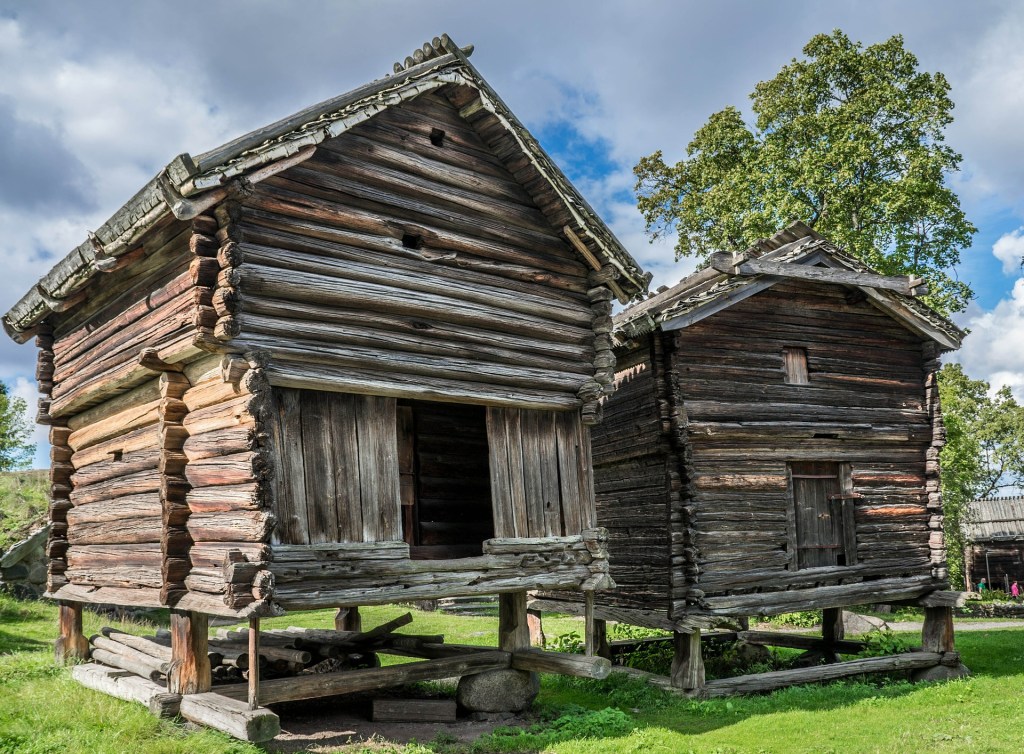
We move on, via a shoesmiths manned by volunteers in period costume of white shirt, colourful waistcoat and cream stockings, past stilt-borne wooden storehouses and a variety of solid-looking 18th-century farmhouses. The phrase stepping back in time was rarely more apt.
We have arrived at what could perhaps lay claim to being a precursor – at least philosophically – of many of modern Sweden’s summer cottages. Painted in yellow and grey this version once belonged the Swedish intellectual and theologian Emanuel Swedenborg and it looks much like a particularly alluring version of a modern shed.
With a sense of historical accuracy, it is still flanked by plants that Swedenborg himself is believed to have cultivated, with roses, hyacinths and tulips all coming into bloom in spring and summer. It’s a backdrop that the great thinker would hopefully still find conducive to getting to grips with the intricacies of faith, nature and the human condition.
In mid-winter, however, snow shrouds Swedenborg’s summer-house. His replica garden is well and truly dormant, and I can feel the chill creeping up into my feet and making inroads through my hat and coat.
There is a place nearby, though, where – winter or summer – the temperature remains the same and which not only offers me the welcome chance to warm up, but also a unique insight into Sweden’s maritime past.

Saved from the sea
A short walk from Skansen, beneath a pitched grey roof topped with a trio of masts, is the Vasa Museum, dedicated to telling the story of the ship that sank on its maiden voyage in 1628, was salvaged in 1961 and today is kept in a state-of-the-art building at a humid 18-20°C and in artificial twilight.
With feeling returning cautiously to my fingers and toes, and in the looming shadow of the once-great warship, I meet curator Magnus Olofsson, an enthusiastic mine of information about how the vessel came to grief and its reincarnation as one of Europe’s most remarkable visitor attractions.
He describes how the Vasa, the newly built flagship of the Swedish navy, emerged from Stockholm’s harbour on its maiden voyage. Despite a relatively calm sea and no more than a light breeze, it was soon yawing alarmingly and, within 1,300 metres of the port’s entrance, it capsized.
‘The reasons behind it are quite complicated,’ he adds, ‘but the easiest explanation is that it had been designed to be far too narrow. People seem to have realised that at the time. They certainly recognised that it wasn’t stable, but they were in a hurry and they just hoped for the best.’
One of the reasons the shipwrights and sailors made what was in retrospect such a foolhardy decision was that nobody was keen to tell the Swedish King, Gustav II Aldolf, that his flagship project had gone horribly wrong.
The current Vasa Museum opened in 1987 and the vessel itself is an impressive sight, gunports open, intricate carvings still intact and masts rigged, it appears like a wooden cliff-face above the heads of visitors. That, confides Olofsson, is the whole point. ‘The ship is bigger than almost everybody expects anyway,’ he says, ‘but the space has been very cleverly used to make it seem even larger and more dramatic than it actually is.’
At a level with its keel, visitors look up with expressions of awe and surprise towards the bulwarks, gun-ports and decks above their heads. But it is more than just the ship’s size that lures visitors, adds Oloffson. ‘This is the only complete vessel from the 17th century anywhere in the world and it’s easy for people to understand its story. The mystery surrounding how it sank is also something that intrigues and that’s partly because what was created that day was a time capsule that can take you back to 1628.’
This becomes particularly clear in a permanent exhibition entitled Face to Face, which, somewhat disconcertingly, contains the skulls and bones of several of the 30 or so people who are thought to have gone down with the ship, alongside recreations of some of their faces.
Among these is a man in late middle age, with a balding scalp and greying beard. His skeleton was found to have a damaged foot and leg and still bore traces of a finely made woolen coat. The remains, researchers believe, are probably those of an experienced naval captain, Hans Jonsson, who had been invited on board Vasa as a guest and was caught below decks when the ship sank.
The museum has been designed so the ship is an unavoidable presence wherever you stand. ‘Even in the dedicated exhibition spaces you’re still able to see it,’ says Olofsson, ‘so you can always relate what you’re seeing to the boat itself. There are no walls or partitions so everything is in a direct line of sight.’
Indeed, so complete and seemingly solid is the vessel, it is all too easy to forget that it spent three centuries beneath the waters of the Baltic sea. Its very existence is a tribute to those who restored it and continue to labour so the ship can hold off the ravages of time and elements.

‘The restoration and maintenance work is a never-ending story, it just goes on and on, all the time,’ adds the curator, with a hint of a shrug. ‘Wood that’s been under water for so long doesn’t really like to be exposed to the air. It begins to oxidise and that starts a chain reaction that basically means it isn’t as stable as it was in the 17th century. We know nothing lasts for ever, but we think Vasa should be here for at least another 1,000 years.’
When I finally tear myself away from the warm, humid, echoing precincts of the Vasa Museum, the sun has long since set and flurries of snow are flickering past the streetlights of Djurgårdsvägen.
A few people, bundled up against the wind are rapidly making their way home, hats pulled down and collars turned up. There is no doubting that winter and darkness are in the ascendancy, but they won’t be for much longer. In a few months, this place will be full of spring flowers and sunshine and Stockholm’s thoughts will be turning to long summer nights, the delights of an evening swim and a much-anticipated escape to the countryside.
 Dan Hayes: journalist & writer