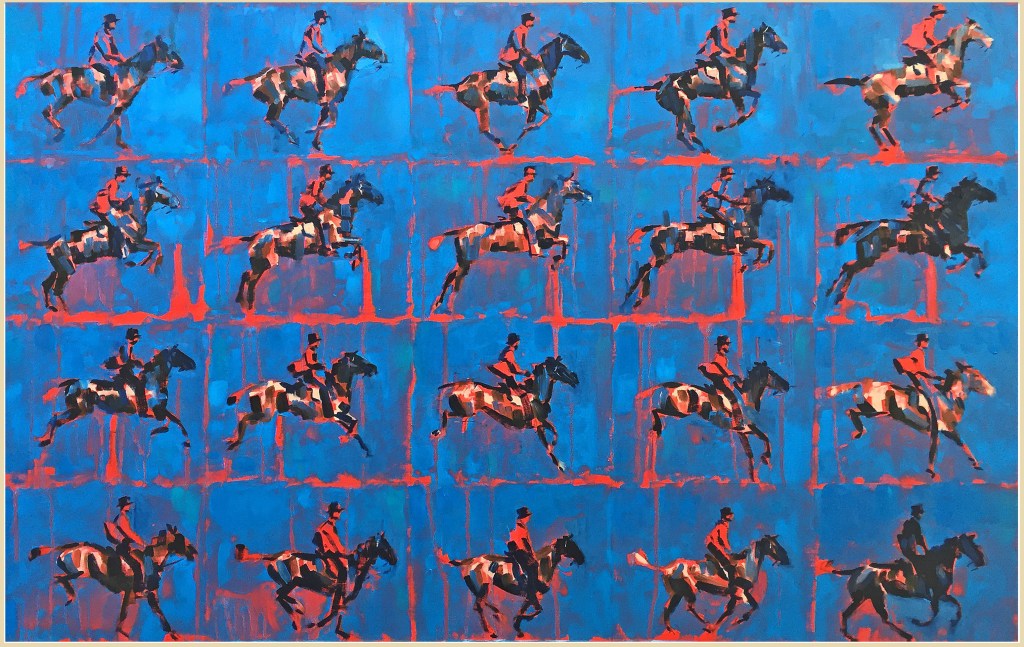
Freddy Paske is an artist whose work bears the influences of his former career. As an officer with the Light Dragoons in Afghanistan his role was to perform long-range reconnaissance patrols into the desert, often for two to three weeks on end, on the lookout for evidence of enemy activity.
The contrast of wide, blue skies and the vast quantities of dust kicked up by tyres and tracks proved inspirational for Paske.
‘It was really interesting to explore Afghanistan through paintings as a way of appreciating its scenery, but I was also out there as a soldier and a commander and so I was really busy most of the time. It was only on very rare occasions that I got the time to paint.’
The realities of the situation in which Paske found himself influenced the style of the work he produced. They capture a sense of speed and drama with swirling colours and dramatic shadows that recall the strength of a desert sun.
And while many artists have visited Afghanistan and other parts of the world with British troops in recent decades, very few have had Paske’s intimate knowledge of the realities of the front line.
‘I think I could probably count the number of artists who actually served in Afghanistan on the fingers of one hand,’ he says. ‘I think it gives you a different perspective to someone who has been brought in purely to document what they see solely as an artist.’
He also found the soldiers with him were appreciative of his art.
‘You might think that these would be two very different professions that didn’t really mix, but in fact they were really supportive,’ he recalls, ‘I still get guys with whom I was in army asking me if they can have a copy of a particular sketch or painting in which they were featured.’
Paske spent seven years with the Light Dragoons and in that time was posted not only to Afghanistan, but also to countries such as Bosnia, Canada and Kenya, all of which helped provide inspiration for his art.
Sporting subjects
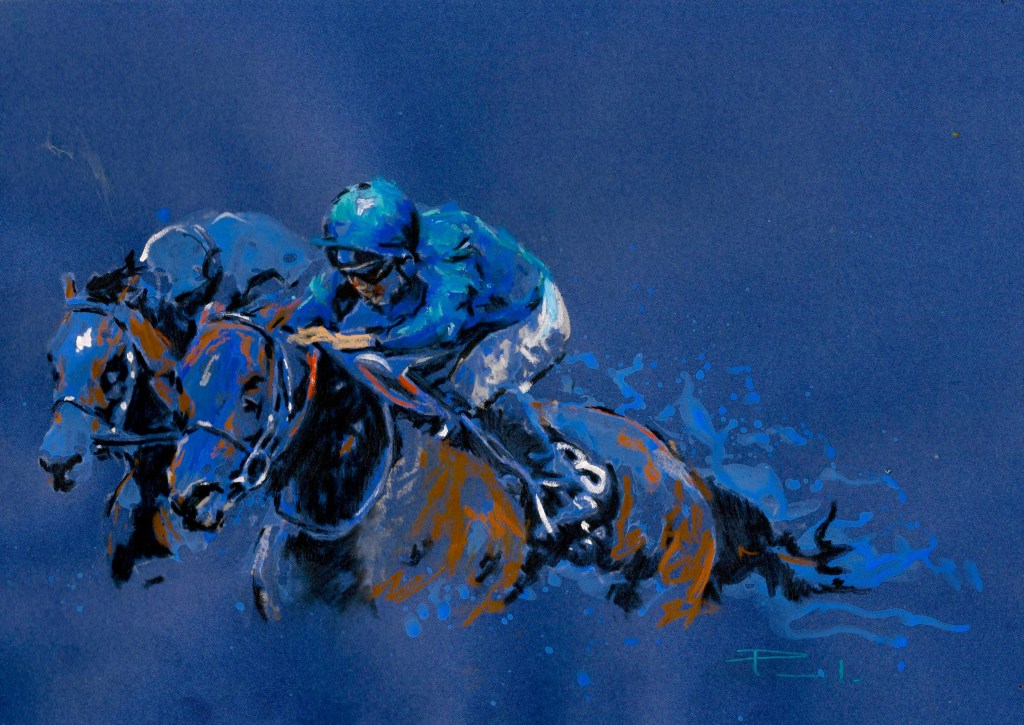
Having now left the army he is making a name for himself primarily for his depiction of sporting and wildlife scenes. He finds horse racing in particular to have a number of similarities with the realities of his military artworks.
‘It’s all about capturing a sense of movement and colour,’ he says. ‘In my previous profession I didn’t have long to create my works and racing is like that as well. There are the jockeys’ brightly coloured silks, the feeling of excitement and the sense of what it must be like riding those horses. I try to capture all that in a painting – this idea of an intense 15 minutes that ultimately gives you a winner and a loser.’
One of his first projects was based on his girlfriend’s racing tips. She was knowledgeable about form and Paske would paint fancied horses before and after a race and then post the images on social media, capturing the urgency and drama of the spectacle.
While this series and Paske’s other racing scenes have been well-received he is looking somewhat further afield for his next major project.
‘I’ve lived in the country all my life and I’ve always been interested in wildlife,’ he explains. ‘As an artist you can become very self-centred, which is very different from being in the military where you really could see the benefits of what you were doing on ordinary people’s lives.’

The Bigger Picture
Paske felt he needed a challenge that somehow bridged that gap and he discussed it with photographer David MacKay – a fellow military veteran who served a full 22-year career in the Army.
Together they set up The Bigger Picture project and came up with the idea of spending time with an anti-poaching unit in Zambia, both to highlight the plight of the region’s wildlife but also to shine a light on the wider implications of the trade in animal parts around the world.
‘We’ll be embedded with them in a way that war artists would join up with a military unit,’ says Paske. ‘We’ll be trying to capture what life is like for them and what they do on a day-to-day basis.’
The pair teamed up with a professional fundraiser, Liz Parker who raised £33,000 to fund their expedition with the official sponsors being risk management firm Janus Global Operations and British charity the David Shepherd Wildlife Foundation providing support.
‘It’s a really exciting project,’ Paske says, ‘With our military background we should be able to do anything the anti poaching rangers can do over the course of a month. Artists generally just observe, but we’re hoping to go further than that and to really capture the experience first hand rather than as journalists.
‘We settled on anti-poaching as a project for a number of reasons,’ he adds. ‘The trade in wild animals is worth around $80 billion a year and much of that money is going into areas of conflict such as Afghanistan, Iraq and Syria. In northern Africa, ivory is being used as a non-traceable form of currency to fund insurgent groups such as Al-Shabaab and Boko Haram to help them gain influence and weapons.
‘With that in mind the anti-poaching rangers are doing a really important job. We also want to find out what motivates them and what persuades them to do this job – especially when many of them will have fathers, brothers or cousins or have themselves been forced into poaching because of factors such as crop destruction by the very animals that they’re trying to protect.’
For more about Freddy Paske’s work, click here.
 Dan Hayes: journalist & writer